
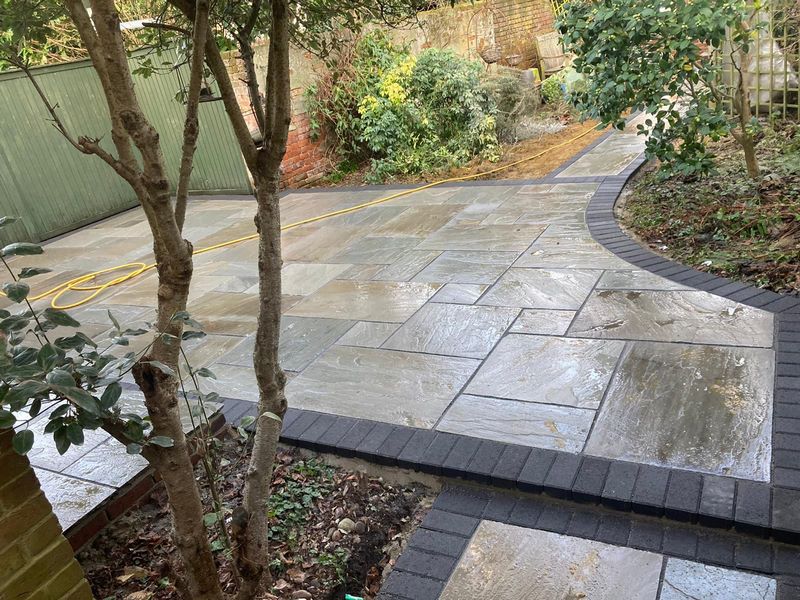
Why Does Water Pool on My Patio? Causes, Problems and Solutions
A few puddles immediately after heavy rainfall may not seem unusual, but water that regularly collects in the same areas of your patio can be a sign that something isn’t working correctly.
A well-designed patio should direct water away from your property and towards an appropriate drainage point.
If water continues to sit on the paving long after the rain has stopped, it is worth finding out why.
Here are some of the most common reasons for water pooling on patios and what can be done about them.
1. The Patio Doesn’t Have Enough Fall
Patios may look perfectly flat, but they should normally have a slight gradient — commonly referred to as the fall — to help rainwater move in the intended direction.
The gradient is subtle enough that you shouldn’t notice it when using the patio, but it makes an important difference when it rains.
If the paving was installed too level, water has nowhere to go and can remain sitting on the surface.
An incorrect fall can also direct water towards the house rather than away from it, which is a more serious issue.
2. Some of the Paving Has Sunk
A patio that drained correctly when it was first installed can still develop puddles later.
If one or more slabs sink, they create a low point where rainwater naturally collects.
Sinking can be caused by movement in the ground underneath, a failing base or problems with the material supporting the paving.
Simply filling the joints or cleaning the slabs won’t correct this type of drainage issue. The affected area normally needs to be lifted and brought back to the correct level.
3. The Patio Was Laid on an Inadequate Base
What sits underneath your patio is just as important as the paving you see on top.
Proper ground preparation creates a stable base and allows the paving to maintain its intended levels.
If the base wasn’t constructed correctly, different parts of the patio can settle at different rates. The result may be rocking slabs, uneven joints and areas where water begins to collect.
This is why good groundwork is essential when installing any new patio.
4. Drainage Channels Are Blocked
Some patios use linear drainage channels to collect surface water and carry it away from the property.
Leaves, soil, moss and other debris can gradually collect inside these channels and reduce the flow of water.
If your patio has previously drained well but has recently started developing puddles, checking and cleaning the existing drainage is a sensible first step.
Blocked outlets or underground drainage may require further investigation.
5. The Garden’s Drainage Has Changed
The patio itself isn’t always the source of the problem.
Changes elsewhere in a garden can increase the amount of water reaching the paved area.
New landscaping, extensions, sheds and additional hard surfaces can all affect how rainwater moves around a property.
Likewise, soil that has become heavily compacted or saturated may stop absorbing water as quickly as it once did.
A drainage solution therefore needs to consider the whole surrounding area rather than the patio in isolation.
Why Is Standing Water on a Patio a Problem?
Persistent standing water can cause more than an unattractive puddle.
Damp surfaces provide ideal conditions for algae and moss, which can make patio slabs slippery.
Water can also highlight or worsen problems with loose paving and damaged joints.
During colder weather, water sitting in vulnerable areas can contribute to deterioration through repeated wetting and freezing.
Most importantly, water shouldn’t be repeatedly collecting against the walls of your home.
How Can Patio Drainage Be Improved?
The right solution depends on why the water is pooling.
Possible solutions include:
- Re-levelling isolated areas of paving
- Relaying sections that have sunk
- Correcting the fall of the patio
- Installing or replacing drainage channels
- Clearing blocked drainage
- Redirecting water towards suitable garden drainage
- Reconstructing a patio where the underlying base has failed
For minor problems, only a small section may need attention. If the entire patio has been installed at the wrong level or gradient, more substantial work may be required.
Should Water Drain Into the Garden?
Where conditions allow, directing rainwater towards a suitable permeable area can provide a simple and effective solution.
However, every property is different.
The size of the patio, ground conditions, surrounding levels and location of the house all need to be considered before deciding how the water should be managed.
A professional assessment can identify where the water is coming from and where it can safely be directed.
Patio Installation and Repairs Across Kent
If your patio regularly develops standing water, Kent Drives & Patios can assess the paving, levels and drainage to identify the cause.
We install and improve patios throughout Kent, with careful attention paid to the groundwork and drainage that help the finished surface perform properly for years to come.
Contact us today to arrange a free site survey and discuss your patio or drainage requirements.